


Page 22 - Masala Lite Issue 190 October 2026
P. 22
22      IN FOCUS


            GROUNDS


            Growth


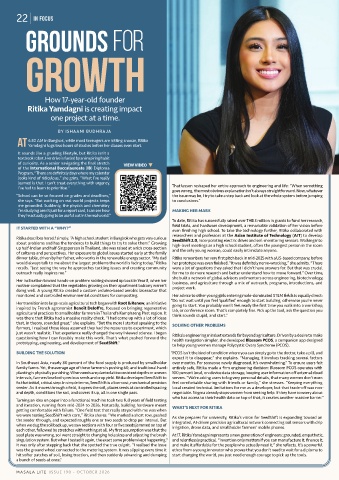
                     How 17-year-old founder
             Ritika Yamdagni is creating impact

                       one project at a time.


                           BY ISHAANI BUDHRAJA
              6:30 AM in Bangkok, while most teenagers are hitting snooze, Ritika
              Yamdagni  logs two hours of studies before her classes even start.
         It sounds like a grueling lifestyle, but Ritika isn’t a
         textbook robot. Her drive is fueled by an inspiring habit
         of curiosity. As a senior navigating the final stretch   VIEW VIDEO

         of the International Baccalaureate (IB) Diploma
         Program, “There are definitely days where my calendar

         looks kind of ridiculous,” she grins. “What I’ve really
         learned is that I can’t treat everything with urgency.
         I’ve had to learn to prioritise."                                   That lesson reshaped her entire approach to engineering and life: “When something
                                                                             goes wrong, the most obvious explanation isn’t always straightforward. Now, whatever
        “School can be so focused on grades and deadlines,”                  the issue may be, I try to take a step back and look at the whole system before jumping
         she says. “But working on real-world projects keeps                 to conclusions.”
         me grounded. Suddenly, the physics and chemistry
         I’m studying aren’t just for a report card, I can see how           MAKING HER MARK
         they’re actually going to be useful out in the real world.”
                                                                             To date, Ritika has successfully raised over THB 3 million in grants to fund her research,
                                                                             field trials, and hardware development, a remarkable validation of her vision before

        IT STARTED WITH A “WHY?”

                                                                             even finishing high school. To take the technology further, Ritika collaborated with
                                                                             researchers and professors at the Asian Institute of Technology (AIT) to develop
        Ritika describes herself simply: “A high school student in Bangkok who gets very curious
                                                                             SeedShift 2.0, incorporating electric drives and soil-monitoring sensors. Walking into
        about problems and has the tendency to build things to try to solve them.” Growing
                                                                             high-level meetings as a high school student, often the youngest person in the room
        up half-Indian and half-Singaporean in Thailand, she was raised at a rich cross-section
                                                                             and the only young woman, could easily intimidate anyone.
        of cultures and perspectives. Her exposure to global issues started early at the family
        dinner table, driven by her father, who works in the renewable energy sector. “My dad   Ritika remembers her very first pitch back in mid-2025 with a US-based company, before

        would always talk to me about the largest problems the world is facing today,” Ritika   her prototype was even finished. “It was definitely nerve-wracking,” she admits. “There


        recalls. “Just seeing the way he approaches tackling issues and creating community   were a lot of questions they asked that I didn’t have answers for. But that was crucial
        outreach really inspires me.”                                        for me to do more research and better understand how to move forward.” Over time,
                                                                             she built a network of global advisors and mentors across engineering, biotechnology,
        Her inclination toward hands-on problem solving showed up back in Year 8, when her
                                                                             business, and agriculture through a mix of outreach, programs, introductions, and
        mother complained that the vegetables growing on their apartment balcony weren’t
                                                                             project work.
        doing well. A young Ritika created a custom arduino-based aerobic bioreactor that
        monitored and controlled environmental conditions for composting.    Her advice to other young girls entering male-dominated STEM fields is equally direct:

                                                                             “Do not wait until you feel ‘qualified’ enough to start building, otherwise you’re never

        Her transition into large-scale agricultural tech began with Root & Renew, an initiative   going to start. You probably won’t feel ready the first time you walk into a workshop,


        inspired by French agronomist Benoît Deloffre, focused on bringing regenerative
                                                                             lab, or conference room. That’s completely fine. Pick up the tool, ask the question you

        agricultural practices to smallholder farmers in Thailand’s Kamphaeng Phet region. It
                                                                             think sounds stupid, and start.”
        was there that Ritika had a massive reality check. “I had come up with a lot of ideas
        that, in theory, sounded great,” she explains. “But the more I started speaking to the
                                                                             SOLVING OTHER PROBLEMS
        farmers, I realised those ideas assumed they had the resources to experiment, which
        just wasn’t realistic. That experience really changed the way I viewed science. I began
                                                                             Ritika’s engineering mindset extends far beyond agriculture. Driven by a desire to make
        questioning how I can feasibly make this work. That’s what pushed forward the
                                                                             health navigation simpler, she developed Blossom PCOS, a companion app designed
        prototyping, engineering, and development of SeedShift.”
                                                                             to help young women manage Polycystic Ovary Syndrome (PCOS).
        BUILDING THE SOLUTION                                                “PCOS isn’t the kind of condition where you can simply go to the doctor, take a pill, and
                                                                             expect it to disappear,” she explains. “Managing it involves tracking several factors
        In Southeast Asia, nearly 80 percent of the food supply is produced by smallholder   over months. For someone newly diagnosed, it’s overwhelming.” To ensure users felt
        family farms. Yet, the average age of these farmers is pushing 60, and traditional hand-  entirely safe, Ritika made a firm engineering decision: Blossom PCOS operates with

        planting is physically punishing. When seeds are planted at inconsistent depths or uneven   100 percent local, on-device data storage, keeping user information off external cloud

        intervals, farmers lose both precious seeds and crop yield. Ritika developed SeedShift to   servers. “We’re asking users to log very personal details, that many women don’t even

        fix that initial, critical step. In simple terms, SeedShift is a low-cost, mechanical precision   feel comfortable sharing with friends or family,” she stresses. “Keeping everything

        seeder. As it moves through a field, it opens the soil, places seeds at controlled spacing   local created technical limitations for me as a developer, but that trade-off was non-

        and depth, conditions the soil, and covers it up, all in one single pass.  negotiable. Stigma already stops women from seeking help. If they have to worry about
                                                                             who has access to their health data on top of that, it creates another massive barrier.”
        Turning an idea on paper into a functional machine took two full years of field testing

        and iteration, running from mid-2024 to 2026. Naturally, building hardware meant
                                                                             WHAT’S NEXT FOR RITIKA

        getting comfortable with failure. “One field test that really stayed with me was when
        we were testing SeedShift with corn,” Ritika shares. “We marked a short row, pushed
                                                                             As she prepares for university, Ritika’s vision for SeedShift is expanding toward an
        the seeder through, and expected roughly one or two seeds to drop per interval. But
                                                                             integrated, AI-driven precision agricultural network connecting soil sensors with drip

        when we dug the soil back up, we saw sections with four or five seeds jammed on top of
                                                                             irrigation, drone data, and smallholder farmers’ mobile phones.
        each other, followed by stretches with nothing at all. My first assumption was that the

        seed plate was wrong, so I went straight to changing hole sizes and adjusting the brush   At 17, Ritika Yamdagni represents a new generation of engineers: grounded, empathetic,

        singulation system. But when I tested it again, the exact same problem kept happening.”   and relentlessly practical. “Invention only matters if you can manufacture it, finance it,

        It was only after stepping back that she spotted the true culprit. “I realised the issue   and make it affordable for the people who actually need it,” she reflects. It’s a powerful

        was the ground wheel connected to the metering system. It was slipping every time it   ethos from a young innovator who proves that you don’t need to wait for a diploma to
        hit softer patches of soil, losing traction, and then suddenly advancing and dumping   start changing the world, you just need enough courage to pick up the tools.
        a bunch of seeds at once.”
        MASALA LITE  ISSUE 190 -  OCTOBER  202 6

